

96% of Boro seedling transplantation completed in Khulna

- Update Time : Tuesday, February 17, 2026
- 939 Time View
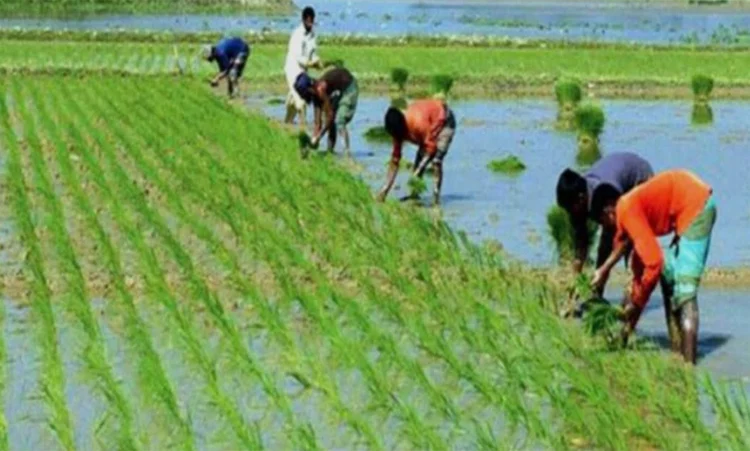
RN Desk: Farmers in the Khulna agricultural region have already achieved 96 percent of the targeted Boro rice transplantation for the current season. Boro seedlings have been transplanted on 96 percent of the designated land in the region—an important milestone expected to boost rice production and further strengthen national food security.
Additional Director of the Department of Agricultural Extension (DAE) in the Khulna region, Md. Rafiqul Islam, told Bangladesh Sangbad Sangstha (BSS) that farmers in Khulna, Bagerhat, Satkhira, and Narail districts are making their best efforts to successfully implement the government-supported intensive Boro cultivation program. The DAE has provided farmers with modern technological support and necessary assistance.
According to sources at the DAE office, a production target of 1,210,283 tons of Boro rice has been set from 264,719 hectares of land in the Khulna agricultural region for the current season. Of this:
- 801,696 tons of hybrid Boro rice will be produced from 162,970 hectares of land;
- 408,299 tons of high-yielding variety (HYV) rice will come from 101,607 hectares;
- 288 tons of local variety Boro rice will be produced from 142 hectares.
As of February 15 this year, farmers have transplanted Boro seedlings on more than 253,252 hectares of land, which represents 96 percent of the targeted cultivation area in the region.
Meanwhile, transplantation of Boro seedlings in coastal lands has already been completed. Farmers have also brought additional low-lying lands, wetlands (beels), and riverbank areas under Boro cultivation. To ensure harvesting before the onset of the monsoon, they are carefully tending the crop.
Additional Director Md. Rafiqul Islam said that, encouraged by the DAE, farmers have adopted conservation agriculture (CA)-based technologies, including the Alternate Wetting and Drying (AWD) irrigation method. These practices aim to save irrigation water and increase rice production at lower costs. So far, farmers have applied organic and balanced fertilizers across the entire targeted 264,719 hectares of land.

List of Advisers
Mohammad Ismail, Former Chairman, Board of Directors, Bangladesh Krishi Bank(BKB) & Prsident , Barisal Bibhag Kalyan Sangstha
Dr. Mohammad Shadi-Uz-Zaman, Managing Director, Natundhora Group, Co-Chairman, FBCCI Standing Committee on Land Developers
Md. Ali Hyder Talukder, Chairman, AHT Agro Industries Limited
Advocate Nasir Uddin Ahmed, Ex-General Secretary, Dhaka Taxes Bar Association
Advocate Munshi Abdur Rahman, A Valiant Freedom Fighter & Legal Adviser, European University Bangladesh, EUB
Dr. Md. Shah Alam FF, Deputy Managing Director, Sobuj Saya Goup
Md. Mahbub Hossain Bhuiya, Managing Director, Matrichaya Properties Ltd.
Md. Altaf Hossain, Senior District & Sessions Judge (Retd) & Legal Adviser, Agrani Bank Limited
Maqsuda Begum, Ex- Executive Director, Bangladesh Bank
------------------------------------------------------------------------------------------------
Editor & Publisher: Mahmudul Haque Khan Dulal
Chief Editor: Md. Delowar Hossain Khan (VP Shahin)
Business Consultant: B.C Sarker
Managing Editor: Md. Arshad Ali
Assistant Editor: Parvin Akter, Fatematuz Johora
Editorial & Commercial Office: 81/C, Kakrail, Dhaka
Mob. 01711356318 (Whats App), 01581053046, E-Mail: dulalkhanm@gmail.com, bbjs.bd15@gmail.com , ( A Publication of MB Media)